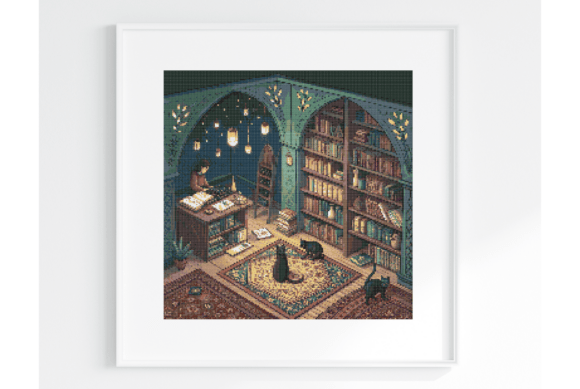
Cozy Bookshop Cat Cross Stitch Pattern
A Practical Review for Small Business Merch & Branded Patches
As an embroidery designer who’s developed hundreds of commercial patterns for cafés, boutiques, florists, pet brands, and handmade studios, I approach every new design with two questions: “Will it translate cleanly to stitched fabric?” and “Does it strengthen brand identity—not just decorate it?” When I first saw the Cozy Bookshop Cat Cross Stitch Pattern, my instinct was positive. The title evokes warmth, storytelling, and quiet charm—ideal for businesses that lean into authenticity over loud branding. The description—“a cute orange tabby in a magical plant-filled room”—signals a friendly, handmade aesthetic: not overly rustic, not sterile or modernist, but gently whimsical and inviting. That tone matters deeply when you’re stitching for customer-facing merch.
How It Performs Across Real Business Applications
The Cozy Bookshop Cat Cross Stitch Pattern shines where personality meets practicality. On embroidered patches—especially 2”–3” woven or chenille versions—it reads clearly as a signature mark for a local bookstore café, indie florist, or creative studio. Its balanced composition (cat centered, soft botanical framing) avoids visual clutter, making it highly adaptable for chest logos on staff aprons or work shirts. For cap embroidery, I recommend using it on the back strap or side panel rather than the front crown—its gentle detail holds up better on flatter, more stable surfaces.
On tote bags and reusable shopping sacks, the pattern adds tactile appeal without overwhelming the canvas. Because it’s rooted in cross stitch—not dense machine-fill motifs—it translates well to lower-stitch-count embroidery files, reducing production cost and wear risk. As an apron embroidery motif, it lends approachability and craft credibility—ideal for bakeries or artisanal shops wanting to signal care and attention. And for product packaging accents (think tea tins, candle labels, or gift tags), the design’s narrative quality invites customers to pause, connect, and remember your brand.
For Etsy sellers and handmade brands, this pattern works especially well as part of a cohesive suite: pair it with simple monogrammed initials or minimalist typography in your digital embroidery file library. It supports visual consistency while keeping each item feeling intentional—not generic.
Where to Use It Thoughtfully
Like any detailed cross stitch chart, the Cozy Bookshop Cat Cross Stitch Pattern requires mindful scaling. At under 1.5”, fine elements—like individual leaves, whiskers, or book spines—risk blurring or disappearing entirely on embroidered patches or cap fronts. Avoid placing it directly on highly curved surfaces (e.g., baseball cap brims or deep-pocketed tote gussets) without testing stitch alignment and fabric pull.
Thread colors matter more here than in bolder graphics. Since the original concept features an orange tabby in a plant-filled room, contrast is essential—especially on dark uniforms or textured fabrics like canvas or twill. Always test your chosen thread palette in black and white first: if values flatten or merge, adjust saturation or simplify outlines before digitizing.
Stitch density also warrants review. While the description mentions a “detailed counted chart,” it doesn’t specify count or complexity—so verify whether the PDF includes guidance for low-density adaptation. High stitch density increases cost, run time, and fabric stress—critical considerations for high-turnover items like staff aprons or event merch meant for frequent washing.
Brand Identity Impact: Beyond Aesthetics
The Cozy Bookshop Cat Cross Stitch Pattern does more than look nice—it signals values. Its handmade origin (as a cross stitch pattern, not a vector graphic) subtly communicates craftsmanship, care, and human scale—qualities small businesses leverage to build trust. Customers don’t just see a cat; they sense warmth, story, and intention. That emotional resonance boosts perceived product value and encourages repeat engagement, especially in spaces where experience matters: boutique retail, community studios, or locally loved cafés.
Used consistently across touchpoints—aprons, tote bags, caps, even printable mockups for social media—the pattern becomes a recognizable shorthand for your brand. But consistency only works if the design scales reliably. That means aligning it with your other design assets: Does it sit comfortably beside your logo? Does its color energy match your palette? Does it feel equally at home on a linen apron and a kraft-paper gift tag?
Essential Embroidery Designer Notes
- Always test in black and white first—to assess value separation before committing to thread colors.
- Check legibility at your target patch size—print the chart at 1.75” and hold it at arm’s length. If details vanish, simplify key outlines or consolidate small elements.
- Review thread color contrast against your most common fabric bases—especially dark denim, charcoal twill, or natural canvas.
- Inspect spacing between elements: tight gaps between plant stems or book edges may collapse in stitching. Allow minimum 0.8mm clearance for clean separation.
- Confirm hoop size compatibility—some cross stitch charts assume large frames, but commercial embroidery often uses smaller hoops. Adjust layout if needed.
- Test on real fabric with proper stabilizer: lightweight tear-away works for smooth cottons; cut-away adds durability for stretchy or textured materials.
- Create a printable mockup for client approval—show how the Cozy Bookshop Cat Cross Stitch Pattern looks stitched on an apron, cap, or tote before digitizing.
- Compare it beside your existing design assets—does it complement or compete? Does it expand your visual language meaningfully?
- Verify commercial licensing before using in paid merchandise, custom apparel, or digital embroidery file resale. Not all cross stitch patterns permit business use—even if labeled “digital PDF.”
Ultimately, the Cozy Bookshop Cat Cross Stitch Pattern isn’t just another graphic—it’s a versatile, emotionally intelligent asset for small business merch. When treated with technical respect and strategic placement, it elevates everything from staff uniforms to customer gifts. For embroidery shops, apparel decorators, and craft-based brands, it’s less about decoration and more about delivering a consistent, memorable, handmade impression—one stitch at a time.