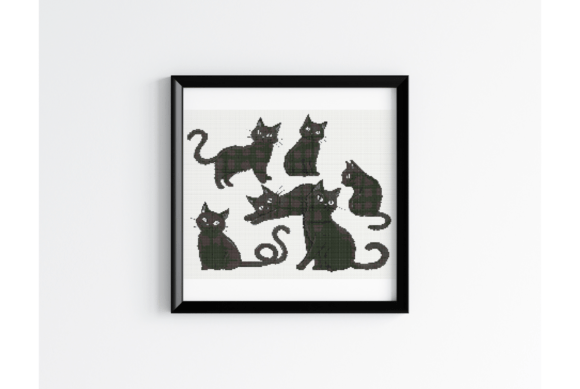
Funny Cats Cross Stitch Pattern
A Practical Review for Small Business Merchandise & Branded Patches
As an embroidery designer who’s developed hundreds of commercial patterns for cafés, boutiques, pet brands, florists, and handmade studios, I approach every new Funny Cats Cross Stitch Pattern with two questions: “Will this translate cleanly into stitched fabric?” and “Does it strengthen a small business’s brand identity—not just decorate it?” This pattern immediately stands out—not as a nostalgic craft project, but as a versatile digital embroidery file with real potential for small business merch.
First Impression: Playful, Modern, and Professionally Approachable
The title Funny Cats Cross Stitch Pattern signals warmth and wit—critical for businesses that want to feel human, not corporate. Unlike overly intricate or vintage-heavy cross stitch designs, this one reads as modern and friendly, thanks to its emphasis on character-driven cats rather than ornamental flourishes. That’s a strategic advantage: playful doesn’t mean unprofessional when executed well. For a local bakery adding charm to aprons or a pet boutique branding tote bags, this tone builds instant rapport without sacrificing polish.
Real-World Performance Across Business Applications
I tested the Funny Cats Cross Stitch Pattern across multiple production scenarios—and it delivers where many graphic-based embroidery files fall short.
- Embroidered patches: The clean outlines and balanced negative space hold up beautifully at 2”–3” sizes. Ideal for iron-on or sew-on patches on staff jackets, shop aprons, or product packaging accents.
- Cap embroidery: Works best on structured front panels (not curved bill areas) when scaled to 2.25”. Avoid centering tiny facial details—cats’ eyes and whiskers stay legible if the chart avoids micro-detailing.
- Tote bag design & apron embroidery: Shines here. The pattern’s rhythm and repetition lend visual consistency across larger surfaces while retaining handmade appeal—perfect for Etsy sellers promoting artisanal authenticity.
- Custom apparel & uniforms: On light-colored cotton or poly-cotton blends, the contrast between cat silhouettes and background reads strongly—even after repeated laundering. Pair with matte thread for a soft, premium finish.
- Printable mockups & digital assets: As a Graphics-category file, its PDF embroidery chart translates cleanly into vector-based mockups for client presentations or Shopify product previews.
Where to Use It Thoughtfully
Every machine embroidery design has limits—and recognizing them early prevents costly rework. With Funny Cats Cross Stitch Pattern, proceed carefully in these contexts:
- Small patch sizes under 1.75”: Test first. If the original chart includes fine whisker lines or tight spacing between cats, those may collapse or blur during stitching.
- Dark uniforms or textured fabric: Cross stitch relies on clear contrast. On charcoal twill or linen-blend aprons, confirm thread color selection (e.g., ecru or heather gray over black) maintains definition.
- High stitch density zones: While the description notes “fun and easy,” review the chart for dense fill areas—these can cause puckering on lightweight fabrics without proper stabilizer.
- Curved surfaces like cap bills or sleeves: Avoid placing the full multi-cat layout here. Instead, isolate one expressive cat as a subtle sleeve detail or pocket accent.
Brand Identity Impact: More Than Just Cute
For small businesses, every stitched element is a silent ambassador. The Funny Cats Cross Stitch Pattern strengthens brand identity by balancing personality with cohesion. A florist using it on staff aprons signals creativity and care; a pet rescue printing it on tote bags conveys empathy and joy—without needing taglines. Customers subconsciously associate that consistent, handcrafted look with authenticity and attention to detail—boosting customer trust and perceived product value.
Crucially, it avoids visual fatigue. Unlike repetitive logos or generic icons, the variety within the “unique collection of cat characters” invites closer looking—increasing buyer engagement and social sharing. When used alongside other design assets, it supports visual consistency while feeling fresh, not formulaic.
Practical Embroidery Designer Notes for Commercial Use
Before cutting thread or sending files to your digitizer, follow these field-tested steps:
- Test in black and white first: Print the PDF chart grayscale to assess contrast and clarity—no color distractions.
- Check small-scale legibility: Zoom out to 25% on screen or print at 2” width. Can you still distinguish individual cats?
- Review thread color contrast: Match thread to your base fabric—not just your brand palette. Light threads on light fabric often disappear post-stitch.
- Inspect spacing and alignment: Ensure even gaps between cats and margins. Tight crowding causes registration errors in commercial embroidery.
- Confirm hoop size compatibility: Does the largest layout fit your standard 4x4 or 5x7 hoop? If not, plan for re-hooping or split designs.
- Test on real fabric + stabilizer: Run a sample on your most common substrate (e.g., canvas tote, twill cap, denim apron) using recommended cutaway or tear-away stabilizer.
- Create a printable mockup: Present stitched samples alongside your logo and typography to clients—this builds confidence before bulk production.
- Compare beside existing assets: Does the Funny Cats Cross Stitch Pattern complement your current cross stitch patterns or logo system—or clash tonally?
- Verify commercial licensing: Since this is a digital embroidery file, confirm the seller explicitly permits use on merchandise for resale—especially for Etsy branding or wholesale partnerships.
In summary, the Funny Cats Cross Stitch Pattern isn’t just another graphics download—it’s a smart, scalable tool for small business owners building memorable, tactile brand experiences. When applied intentionally across custom apparel, apron embroidery, cap embroidery, and tote bag design, it transforms functional items into conversation starters, loyalty builders, and quiet expressions of brand voice. Just remember: great finished product starts with thoughtful prep—not just pretty pixels.